Showing posts with label sin. Show all posts

Thursday, June 21, 2012

Forgive and Forget?


Forgiving someone of a  wrong they have done you can be very healing, both for them and for yourself. You no longer have to carry around that load of hurt, day after weary day. 

Sometimes we are told we should 'forgive and forget', which sounds all noble and good, but is it really good advice, or even do-able?

We may have grown up being told this from the pulpit, held up to us as an 'ideal' we should aspire to, but where did this ideal come from? 

"For I will be merciful to their iniquities, And their sins will I remember no more." 
- Hebrews 8:12. 

Sounds like 'forgive and forget' doesn't it? Yet it isn't. God doesn't forget anything! Yet here He says He will remember our sins no more. There's a difference there, an act of will. An act of love.

God chooses to not bring our faults to mind, He chooses to not hold them before us, or hold them against us. He knows all about them, but puts them aside, "As far as the east is from the west, So far has He removed our transgressions from us." - Psalm 103:12.

What if we forget? A large part of our experience in life that brings us wisdom and maturity comes from remembering things we go through. If we forgot those things, we would being going backwards in our growing! We aren't asked to forgive and forget, but to emulate God's ideal, forgive the hurt and choose to not hold it against them.

It's still a tough act to follow, but it is an act of love.


Sunday, August 8, 2010

How small is God?

The conscious knowledge we have of the size and awesomeness of the universe affects our subconscious view of our place in the scheme of things. And when, like me, you grow up being told that God has a personal interest in you, yet you are learning how staggeringly vast the universe is, you begin to wonder, just who am I to a God who is so immense?

The most learned and quoted Bible verse, John 3:16, says "For God so loved the world that he gave his one and only Son, that whoever believes in him shall not perish but have eternal life." This verse tells us that God can and does view and think about the whole world and all in it. We also learn, that God is able to centre on the individual, the 'whoever' that believes gains eternal life.

That's all well and good as far as theology goes, but how does that pan out in real life?

For that we need to look at 'the exact representation of God', Jesus Christ. 

If we look at the event of the crucifixion, we see amazing things happening. In Luke 23 we read "One of the criminals who hung there hurled insults at him: 'Aren't you the Christ? Save yourself and us!' But the other criminal rebuked him. 'Don't you fear God', he said, 'since you are under the same sentence? We are punished justly, for we are getting what our deeds deserve. But this man has done nothing wrong'. Then he said, 'Jesus, remember me when you come into your kingdom'. Jesus answered him, 'I tell you the truth, today you will be with me in paradise'."

Here was Jesus, fulfilling the plan to bring redemption to the world through becoming our sin on the cross, and some guy interrupts him with the request to gain God's favour! And the remarkable this is Jesus takes the time and effort to regard this one person even when He was dealing with the sin of the whole world! You can learn from this that Jesus is vitally interested in your salvation whenever you come to Him. He will never fob you off as being unimportant or a waste of His time.

Another amazing event that occurred during the crucifixion is seen in John 19. "Near the cross of Jesus stood his mother, his mother's sister, Mary the wife of Clopas, and Mary Magdalene. When Jesus saw his mother there, and the disciple whom he loved standing near by, he said to his mother, 'Dear woman, here is your son', and to the disciple, 'Here is your mother'. From that time on, this disciple took her into his home." 

In the middle of all His agony, Jesus looked to the practical needs of His people. Being a Christian isn't all about learning some set theology, or memorising set prayers by rote, it's all about your life. The whole of it. And Jesus showed He is interested in being allowed to help you in all areas, spiritual, physical, practical, emotional.. all of it. 

One of my favourite verses says "In ALL your ways acknowledge Him and He will direct your paths." Jesus is to be Lord of all your life, not just some small compartment. 

Another lesson can be learnt after the resurrection, when Jesus had appeared several times to a variety of His followers. Thomas though, had missed out, and wouldn't take the word of the others that Jesus was alive. We all have doubts at times, and we sometimes need to have a personal experience of something before we can take it on board. Thomas had said (John 20), "Unless I see.. unless I feel..". Jesus sought Thomas out, and took the time to deal directly with the questions and doubts Thomas had. 

Jesus is directly aware and interested in how you are feeling and thinking, and He wants to answer your questions and doubts. Jesus at times wants us to believe in things that are yet to happen (such as our future with Him), but He never asked His followers to believe in the false or faulty. 

Jesus doesn't want brain-dead believers. He simply wants believers.

Through these events, we can see that Jesus is vitally interested in your salvation, you are very important to Him, and that is based on His love of you (For God SO LOVED the world)...

We also learn that Jesus is interested in helping us in the whole of our lives, including the day-to-day practical boring or troublesome stuff. 

And we learn that Jesus wants to answer our doubts, questions and queries we have.

What are you waiting for?....

Sunday, July 11, 2010

What's the big deal about crucifying Christ?


Well, yeah, crucifixion is a horrible way to die.... first you would be beaten, whipped, kicked, punched and tortured by the prison screws (John 19:1-5), then you would have to carry the cross you were going to be executed on to the killing field (John 19:17), you would be in severe pain and dehydrated, weak, stumbling and distraught.

You would then be stripped, forced to lay on the cross on the ground and nailed to it. Then the cross would be hoisted up and dropped into a hole and fixed there. Now it was just a matter of time. Near impossible to keep breathing as you got weaker, previous trauma from the torture untreated, the lack of water would accelerate your demise, and help drive you into even greater despair. If time wasn't pressing, you would be left there to die over the next few days. If they wanted you dead quickly, your legs would be broken, and you would no longer be able to lift yourself up enough to take in more air.

So, not a pretty site, but the Romans crucified thousands. So what was so special about Jesus being killed in this way?

The unique point about the death of Jesus was not just the horrible way he was killed, but the way God put the sin of the world on him. This was the whole point of the death of the eternal Son of God. Jesus was the 'sin-bearer', and that aspect of his death sets him apart from any other sacrifice ever made.

We are told, "He himself bore our sins in his body on the tree, so that we might die to sins and live for
righteousness; by his wounds you have been healed." (1 Peter 2:24)

Jesus went to the cross knowing that he would become the target for God's dealing with sin. Job describes it in this way, "God has shriveled me up... his anger has torn me and hunted me down... God hands me over.. and tosses me into the hands of the wicked... He shattered me... He has grasped me by the neck and shaken me to pieces... He has also set me up as His target... He breaks through me with breach after breach" (Job 16). While suffering on the cross Jesus cries out, "Why have you forsaken me?" Christ was bearing the due process of God's law against sin, SO THAT WE COULD ESCAPE AND BE SAFE.

The ultimate torture that Jesus suffered wasn't the whips, the thorns into his flesh, the vinegar for his thirst, the nails pinning him to the wood, the desertion by his followers, or the jeers of the crowd, but the sin and separation he went through for us. And that final battle against our fallen nature was when God won the war to bring us back into His realm.

Christ became sin so that we could become righteous.

Sunday, April 11, 2010

Restoration at work


Restoring an old car takes quite a lot of time, dedication, ingenuity and quite often a lot of money. Imagine what restoring an old train would be like!

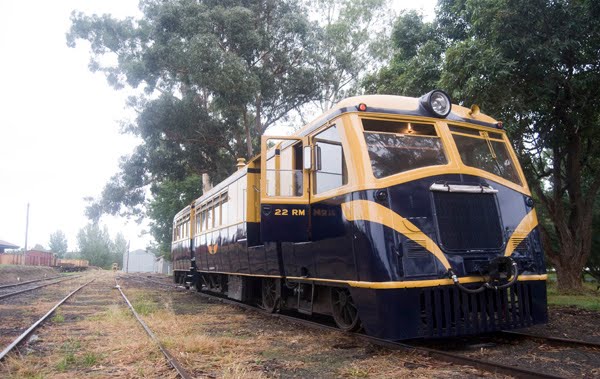
I was invited out to take a ride on the newly restored RM22 rail-motor diesel at Healesville railway station. Now I'm not a train buff, but I could see even through my ignorance of trains the level of dedication and expertise that would be needed to get such a restoration job right.

Unlike restoring a car, when you restore a train to working condition, there's also the infrastructure that needs to restored and maintained. Tracks, sleepers, points, painting, even weeding needs to be kept on top of so the train can be used.


The President of the rail society involved in all this work said they run their projects on the 'right first time' principle. They make sure the materials are the best, and they take whatever time it needs to to the job well so as it doesn't have to be redone.

That reminds me so much of how God worked in restoring us. The Bible says we were born broken (for all have sinned - Romans 3:23) and needed to be brought back to a good and healthy relationship with God.

That restoration was going to need to be done properly, using the best available, taking the time required, and it was going to cost.

God didn't do a quick fix to bring us back to him, he took his time (For while we were still helpless, at the right time Christ died for the ungodly - Romans 5:6)

And God used the best available to restore us. The most well known verse in the Bible says "For God loved the world so much that he gave his only son, that whoever believes in him should not perish, but have everlasting life." (John 3:16)

God was willing to pay the ultimate price to restore us fully to himself. No half measures, no holding back. It cost him his son, who came to bear our sin and the separation that it made between us and God himself. That is what easter is about - the sacrifice Jesus made to put himself between God and our sin. And in the end Jesus said "It is finished", the work was done, the way was made open for us to come back to God and be made holy!

Imagine that, we can be seen by God to be sinless, as we accept what Jesus has done for us by his death on that cross.

Because that is what is presented to us. A gift. The free gift of salvation. God has paid for it, Jesus has died for it, and now we can receive it. The gift of a fully restored relationship with God, and all that comes with it.

God is handing that gift to you. Your job is to take it.

Friday, April 9, 2010

Parable of the bird

If you've ever been up in a light plane, glider, or even a hot-air balloon, you'll remember the unique aspect of being able to travel in that extra 'dimension', not being restricted to the ground. You may have thought about the freedom of movement enjoyed by birds, where they can simply fly over obstacles that we have to try to find a way around.

The Bible even talks of that type of freedom being available to our spirits when God is our focus. Our youth is renewed like the eagle, etc. In Christ, we are told we have freedom from the things that bind us and anchor us down.

My family have been watching a small blue wren that lives in bushes on our property.

This wren came to our notice by repeatedly landing on our window sills, and tapping on the glass. It also stands on the doorstep and taps on the glass sliding door.

At first we thought that was pretty cute, here was this lovely looking bird wanting to come and live in our house. We got to the stage of looking carefully around whenever we wanted to go outside, making sure we didn't let it slip in.

Soon though, we were thinking, "Is this bird a bit demented?". Why would it want to come into an environment that restricted it so much? Why would it want to give up its freedom?

Outside, it had no restrictions on it, travel was unimpeded, food was there for the taking.

In our house though, it would find walls, a ceiling, and boundaries all around. It would lose all it had if it came inside. It would also quickly lose its life, as our cat was just itching to have it for breakfast!

This all made me think of the stupidity of christians who actively seek to give into temptation. God gives his followers immense freedoms. Through the sacrifice of Christ, we gain:

freedom to call God our father.

freedom to talk to God.

freedom to do his will.

freedom to excercise the gifts he gives us.

freedom to see the world as it really is.

freedom from fear of judgement.

freedom from God's anger.

freedom from guilt.

freedom to call on him for help.

Imagine wanting to give up those freedoms for restrictions. To place yourself back into a position where you:

were estranged from God.

cut yourself off from his counsel.

had to rely on your own guidance for your life.

weren't capable of doing work that was of lasting value.

were blinded and unable to see the truth.

knew God would have to deal with your rebellion.

knew God was not pleased with you.

were no longer happy and carefree.

were left feeling on your own.

You'd have to be stupid! And sometimes christians are. We get to thinking that a little bit of sin is o.k. We forget about the price-tag that sin has on it. We delude ourselves into thinking we can practice 'safe sin'.

Sorry, but there ain't no such thing.

Saturday, April 3, 2010

The last TimTam


Each time you get cut off in traffic, or a neighbour plays music way too loud in the early morning, or you decide to eat the last Tim Tam without asking if your partner would like it, that's selfishness at work.
Each time someone decides they are more important than everyone else, selfishness is saying
"eat my dust, suckers".

Selfishness is a direct result of the 'Me generation" lifestyle. The philosophy that says
'look after yourself first', and 'you are the most important person in the world'. The sad thing is, you find this philosophy plainly written in many 'self-help' books.

By any reasonable way of thinking about it, selfishness is a problem causer. It creates conflict. It escalates one above the many. It puts others down. It causes pain.

In the Bible it's called a
sin.

It's a part of the human condition, which the Bible calls our fallen nature.
Thankfully, the Bible doesn't just identify the problem, it teaches a lifestyle that endevours to defeat the problem.

In a letter called Philippians, it says
"let each of you regard one another as more important than himself."

What a life changing revelation! To treat
other people as being more important than yourself, to give others then best, to give way, to think of others first.

It's a huge turn-around to the way the world pushes us to live. So how about just starting small. Work your way up slowly. Start to practice giving way on the road. Make way for people. Think about what you do, that you don't create a problem or more work for others.

Start to live with other people in mind.